


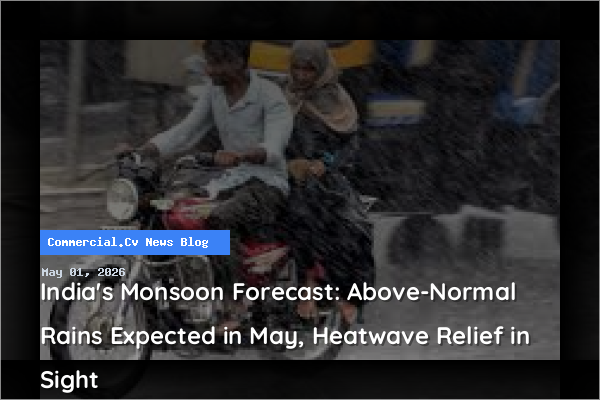
Monsoon Mayhem or Welcome Relief? IMD Predicts Abundant Rainfall for India
As India grapples with soaring temperatures and the relentless grip of a severe heatwave, a beacon of hope has emerged from the India Meteorological Department (IMD). The national weather forecasting agency has issued an alert predicting a "rain explosion" in May, with forecasts indicating above-normal rainfall in several parts of the country. This development is being closely watched by businesses, agricultural sectors, and citizens alike, as it promises significant relief from the oppressive heat and has broader implications for the Indian economy.
Background: The Onset of Summer and Prevailing Weather Patterns
May typically marks the transition period in India, where the intense heat of summer begins to wane, often accompanied by pre-monsoon showers. However, this year, many regions have experienced prolonged and severe heatwave conditions, pushing temperatures to dangerous levels and impacting daily life, agriculture, and public health. The IMD's forecast of increased rainfall in May comes as a crucial update, offering a potential reprieve from these extreme weather events. The arrival of the monsoon season, which officially begins in June, is vital for India's agrarian economy, with a significant portion of the country's food production dependent on timely and adequate rainfall.
Key Developments: IMD's Forecast and Regional Projections
According to reports citing the IMD's latest projections, the month of May is expected to witness a substantial increase in rainfall activity. The forecast suggests that several areas might experience rainfall significantly above the long-period average. While specific regional breakdowns are still being detailed, the overarching sentiment is one of increased precipitation compared to drier spells experienced in previous months. This surge in rainfall is anticipated to be driven by a combination of meteorological factors, potentially including the development of low-pressure systems and increased moisture influx. The IMD's alert has been disseminated to various state governments and disaster management authorities to ensure preparedness.
The anticipated "rain explosion" is not just about increased rainfall but also includes the possibility of thunderstorms and strong winds, characteristic of pre-monsoon activity. While these events can bring much-needed cooling, they also carry the risk of localized damage. The IMD's advisory emphasizes the need for vigilance and preparedness to mitigate any adverse impacts from these weather phenomena.
Impact & Analysis: Economic and Social Repercussions
The implications of an above-normal rainfall forecast for May are multifaceted and significant for India. For the agricultural sector, this is particularly welcome news. Farmers have been contending with water scarcity and crop stress due to the heatwave. Abundant rainfall in May can help replenish soil moisture, support the sowing of Kharif crops, and alleviate the immediate pressure on irrigation resources. This could potentially boost agricultural output and contribute to stabilizing food prices. The economic impact extends to sectors reliant on agriculture, including food processing and rural markets.
Beyond agriculture, the increased rainfall is expected to provide much-needed relief from the intense heatwave. This can lead to a reduction in heat-related illnesses, improve air quality, and contribute to a general sense of well-being among the population. For businesses, particularly those in energy and water management, the forecast necessitates strategic planning. Reduced demand for cooling systems due to lower temperatures could impact energy consumption patterns. Conversely, increased water availability can benefit industries that rely heavily on water resources.
The IMD's forecast also has implications for water resource management. Reservoir levels, which are often depleted during summer, could see a replenishment, easing concerns about water availability in the short to medium term. This is crucial for urban water supply, industrial use, and hydroelectric power generation.
What's Next: Preparedness and Monitoring
As the IMD continues to monitor weather patterns closely, the focus now shifts to preparedness and adaptation. State governments and disaster management agencies will likely enhance their preparedness measures to handle potential localized flooding or strong winds associated with the pre-monsoon showers. Public awareness campaigns regarding safety during thunderstorms and heavy rainfall will also be crucial.
For businesses, this forecast presents an opportunity to review and adjust operational strategies. Sectors like agriculture, retail, and energy will need to factor in the potential shifts in consumer behaviour and resource availability. The technology sector, in particular, might see increased demand for weather-related applications, agricultural tech solutions, and smart water management systems. As the monsoon season officially approaches, the IMD will continue to provide updated forecasts, guiding the nation through this critical period.
Source: AajTak



Share on